3. Medication access
Status: data published September 2026; family guide in review.
The gap
For most conditions a missed dose is a nuisance. For epilepsy, going without medicine for a stretch is what causes harm. In a study of 33,658 adults with epilepsy on Medicaid, the periods when people were not taking their medicine carried about three times the death rate, one and a half times the emergency visits, and twice the rate of injury-causing crashes. A single forgotten dose is a different thing, and a 2026 study found that missing a dose the day before did not raise seizure risk. Nationally, among adults with active epilepsy, about 13 percent say they could not afford their prescription and about 9 percent skip doses to save money. Adults without epilepsy report about 6 percent on both of those questions. Two other things stand between a Minnesota family and the pill: supply problems (FDA currently lists a valproate injection shortage open since 2020, and discontinuations of several other seizure products) and distance. Minnesota has lost 13 percent of its community pharmacies since 2009, and about one in five residents now lives in a low-access area.
What the data shows
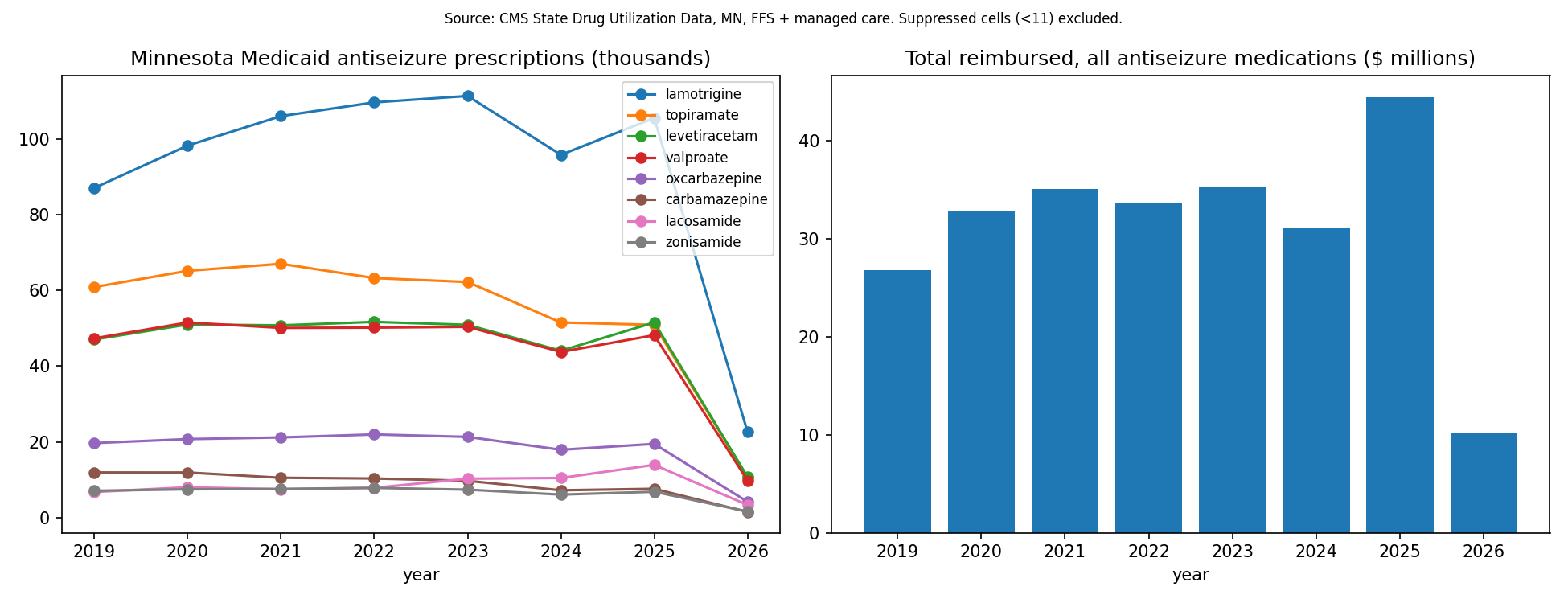
We pulled every Minnesota Medicaid antiseizure prescription from 2019 through early 2026 from the federal State Drug Utilization Data.
| 2025 | Value |
|---|---|
| Antiseizure prescriptions paid by Minnesota Medicaid | about 335,000 |
| Total reimbursed | $44 million |
| Average cost, lamotrigine (most common) | $24 per prescription |
| Average cost, rescue diazepam | $1,444 |
| Average cost, cannabidiol (Epidiolex) | $3,739 |
| Average cost, vigabatrin | $13,724 |
Clobazam prescriptions fell 34 percent between the first and second quarters of 2024. We first read that as a shortage, and we were wrong. We checked both national shortage trackers as they stood during 2024, using archived snapshots of the FDA list and the ASHP list, and neither recorded a clobazam shortage that year. The only clobazam entry anywhere is one company discontinuing its 20 mg tablet. Sixteen other seizure medicines fell by a fifth or more in the same quarter, and a shortage hits one drug at a time. Minnesota's Medicaid renewals after the pandemic ran through mid-2024, which fits the pattern better. Medicaid covers at most a third of Minnesotans with epilepsy; commercial claims are held by MDH and we have asked for them.
What a Minnesota family actually pays
Medicaid prices are not what a working family sees. In September 2026 we pulled the federal drug pricing file, checked which seizure medicines have a generic, priced ten real Minnesota insurance plans, and read the state's own claims data. Four things stand out.
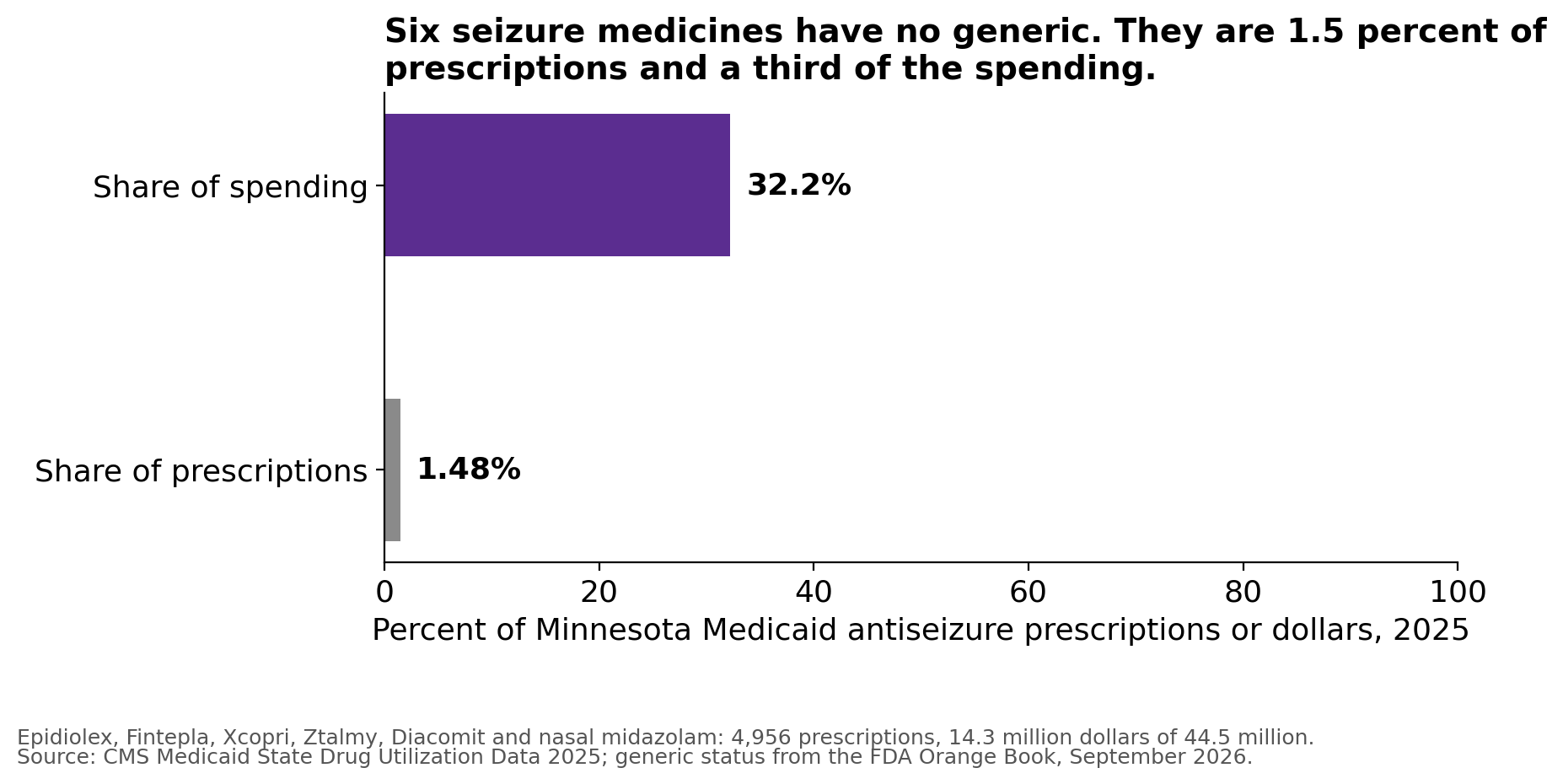
Six seizure medicines have no generic at all: Epidiolex, Fintepla, Xcopri, Ztalmy, Diacomit and nasal midazolam. In Minnesota Medicaid they are 1.5 percent of seizure prescriptions and 32 percent of the spending.
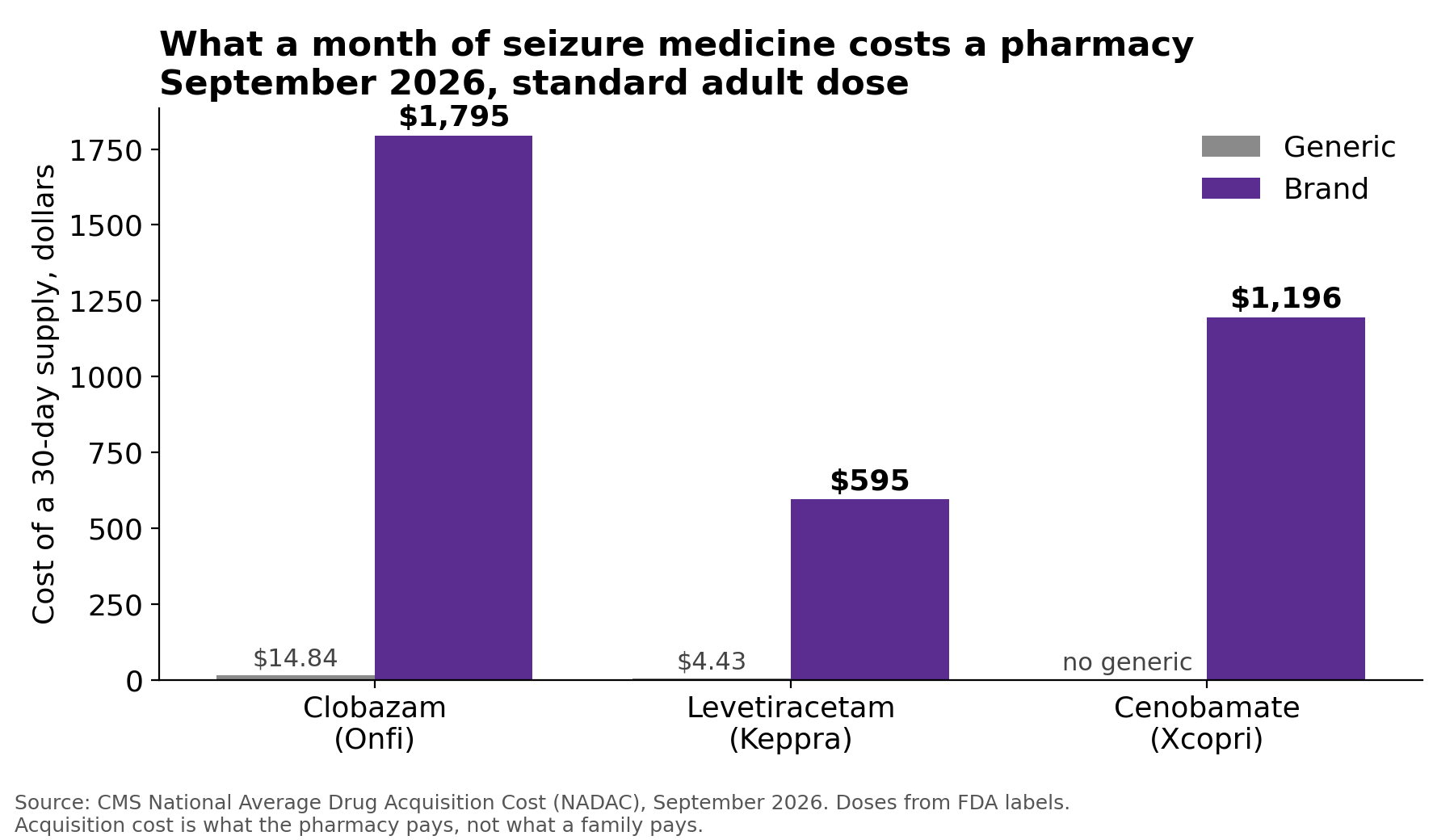
Where a generic does exist, the gap is enormous. A month of generic clobazam costs a pharmacy about $15. The brand, Onfi, costs about $1,795. Generic levetiracetam is $4.43 against $595 for Keppra. Some children cannot switch between versions without losing seizure control.
Minnesotans on commercial insurance pay far more than people on public programs. From the Minnesota All Payer Claims Database for 2022: $18.48 out of pocket per fill on a commercial plan, against $9.30 on Medicare and $1.31 on Medical Assistance. For the expensive drugs the median payment is $0.00 while the average runs from about $96 to $267 a fill, which is the deductible pattern. Across a year, commercial members taking fenfluramine paid $1,822 on average, eslicarbazepine $1,460, and cannabidiol $1,073. Those three averages rest on small numbers of people, 12, 13 and 71 respectively, and the database holds roughly 40 percent of Minnesota's commercial market, so read them as the shape of the problem rather than a statewide count.
Prices keep rising, and the state knows it. Minnesota's drug price transparency law requires manufacturers to report large increases, and since January 2022 they have reported 50 on seizure drugs. Sabril rose about 15 percent in twelve months, to $20,182 for a bottle of 100 tablets. Onfi rose about 24 percent over three January increases. In each of the three annual reports we tabulated, anticonvulsants were a top-ten class by number of price increase filings, and the median two-year increase for the class went from 15 percent to 31 percent, though the number of products behind that median also fell. The reasons manufacturers give are boilerplate, and in two cases the reason was withheld as a trade secret.
Bills before the legislature (HF 3652 and SF 3786) would add epilepsy to Minn. Stat. 62Q.481, which since 2023 has capped what a Minnesotan pays for diabetes, asthma and severe allergy medicine at $25 a month. The Department of Commerce, using claims from 2021 to 2024, projects epilepsy cost sharing of $44.71 a month in 2027, with $17.35 of that above the $25 line, and prices the change at four cents per member per month. Both bills died with this legislature and would need to be reintroduced in 2027.
Sources and methods: data/mn_apcd_rx_asm_summary.md, data/nadac_asm_summary.md,
data/mn_brandonly_asm_summary.md, data/mn_plan_cost_sharing_summary.md and
data/mn_rx_price_transparency_summary.md in our public repository.
Explore: which drugs, and what they cost
Click a drug name in the legend to show or hide it. The most common drugs are cheap generics. The drugs a child with hard-to-control epilepsy needs are the expensive ones.
Try it: the pharmacy problem solver
Answer three questions and get the next step for today.
Check yourself
1. A pharmacy is out of your seizure medicine. What is the first question to ask?
"Is this a national shortage or just your stock?" A stock problem is fixed by a transfer or an independent pharmacy; a national shortage needs the prescriber the same day.
2. You have two days of pills left and the plan wants prior authorization. What do you say?
"Emergency supply." Medical Assistance and most plans allow a 72-hour fill while the authorization is processed. Never skip doses while waiting.
3. Why does a broad drop across many drugs in one quarter probably not mean a shortage?
Shortages hit one molecule. A drop across unrelated drugs at once points to fewer people enrolled or late reporting. In 2024 Minnesota's Medicaid renewals fit that pattern.
What we are doing this year
- Keeping this dashboard current each quarter and flagging shortage signals.
- Mapping distance from every school district to the nearest retail pharmacy. First pass, September 2026: 15 districts are more than 15 miles from any retail pharmacy, and 14 of those also post no findable seizure plan. Grygla, Red Lake, Floodwood, and Nett Lake are farthest. Look up any district in the Distance to Care Lookup.
- Publishing a one-page family guide, "When the pharmacy can't fill your seizure medicine," in English, Spanish, Hmong, and Somali, distributed through the Epilepsy Foundation of Minnesota's care coordinators and the pediatric epilepsy clinics.
- Supporting HF 3652 / SF 3786, which would cap what commercial plans can charge for epilepsy drugs at $25 a month, the same protection diabetes and asthma already have. The state's own actuaries priced it at four cents per member per month. Students are ready to testify when it is heard.
Help affording medication now
See Resources & Support for assistance programs, Medical Assistance, and MA-TEFRA.